May 5th, 2015 — The Commission
My original plan was not to blog this build at all — it's the same guitar as my first falcate classical, and I figured I'd covered the ground well enough the first time. That plan lasted about five minutes in the workshop.
This guitar is a commission from my classical guitar instructor. He played the first falcate steel string and loved it — the sound, but also the ergonomic details: the slightly narrower nut, the 20" radius on the fretboard, and the cutaway. He wanted one of his own. That's about the best compliment a luthier can get from someone who plays at that level.
For the wood I chose an Engelmann spruce top and a Panama Rosewood set for the back and sides. The rosewood had outstanding tap quality and stiffness — a set I'd picked up from LMI a couple of years back and had been waiting for the right instrument. The neck is Spanish cedar, a proper classical choice. The only structural change from my first build: braces raised 1mm based on what I learned from that guitar's resonance results.
The eBookThis build was later documented as a full eBook —
Making a Falcate Guitar — with a foreword written by Doug Rice himself.
Download it here.
By the time I posted the first update, the rims were already built and profiled, the neck was prepared, and I was starting on the top and back bracing. Here's where things stood:
The rosette build is documented separately — I posted it in the rosette thread on the forum. The soundhole patch and the start of the back bracing:
May 5th, 2015 — Ditching the Neck Jig for the Table Saw
For the neck tenon I abandoned my Simpson/Woolson-style router jig and cut it on the table saw instead. The jig is a fine tool — its main feature is the ability to set neck angle based on the finished body — but I'd moved away from relying on that anyway. I take great care to get the body angle right during construction, then build the neck to the designed angle. The jig still allowed that; I just set it to rout the angle I wanted. But it meant pulling it out, adjusting it, chucking up a ½" router bit, correctly mounting the neck, and then making a mess.
Table Saw vs. Neck JigThe table saw has a few advantages for a mortise-and-tenon joint. The blade makes a cleaner cut than the router bit. The cheeks can be cut at a very slight angle, which builds in relief — it's easier to floss the correct neck angle into the joint. And with a SawStop saw, the usual anxiety about fingers near the blade is considerably reduced. If I were cutting dovetails instead of mortise-and-tenons, I'd still use the neck jig. For a bolt-on/bolt-off classical neck, the table saw wins.
The bolt-on neck for a classical has one interesting detail: the piece of Spanish cedar glued to the underside of the fretboard extension is planed to a wedge — 4mm at the body end tapering to zero at the nut — to create the negative neck angle that classical guitars require. On a steel string, the neck tilts back to get the action right. On a classical, the geometry runs the other direction.
June 8th, 2015 — Bracing & Closing Prep
Progress has been bit by bit between trips, but the rims, top and back are all ready to close the box. Next step is to route the rims for the braces, do a final neck angle check, and close up.
One thing I noticed during the epoxy sessions: I was measurably less messy than on the first build. Not clean exactly — epoxy is never clean — but more deliberate, more staged. Still room to improve.
September 5th, 2015 — Wrong Top, New Top
One step forward, about eight steps back, then forward again.
I closed the box successfully — and then tapped it and didn't like what I heard. The top resonance came in about 10 Hz lower than my target. I was fairly sure this guitar would end up similar to the first, but I really wanted to hear what a correctly pitched top would sound like. So I ripped the top off with plans to make a new one.
Ripping the Top OffThis is not a decision taken lightly — the bindings were on. But a top that's 10 Hz flat is going to produce a guitar that's acoustically predictable rather than excellent. The Gore/Gilet system is built around measurable targets, and missing the target by that margin undermines the whole approach. Better to start the top over than deliver a guitar that falls short of what the commission deserves.
While the top was off I built a top for an eight-string classical guitar — using 8.5mm braces — and hit my target frequency exactly on that one. Good confirmation that the method is solid; the braces on the original top were just a touch too low.
Meanwhile there was a convenient twist: the very first top I'd prepared for this guitar had been set aside months earlier after I spilled a bottle of brown stain on it — right after the rosette was installed. I'd put it aside in disgust. When I looked at it again, the stain came off with light sanding. I had a perfectly good top with a beautiful rosette already installed, ready for re-bracing with the corrected height. Sometimes mistakes rescue other mistakes.
The Australian Blackwood bindings I'd bent in the Fox bender for the first attempt had cracked, so I bent new ones on a hot pipe. A few things learned from that process: after carefully achieving a perfect bend through the waist and cutaway, it's still possible to crack the lower bout — the bend looks done, but the wood isn't finished moving. Also, bending dry on a very hot pipe works faster than with moisture. The moisture keeps the wood closer to 212°F as it evaporates; a dry pipe gets the wood plastic more quickly. Bending by hand produced bindings that fit the channel without forcing.
Binding the 10' Back RadiusThe bindings fit the plan shape easily but still need to be forced to the 10-foot back radius. That forcing wants to twist the binding slightly so it pulls away from the channel. After gluing, wrapping the whole guitar with a long fabric strip — binding the bindings — closes any gaps while the glue cures.
Happy with the resonance of the new closed box. I think the final guitar will land very close to target.
September 8th, 2015 — Carbon Fiber: Why It's Worth It
A question came up about what the carbon fiber actually contributes to the braces — whether it's just about strength. It's worth answering properly.
Why Carbon Fiber on the Braces?Three reasons. First, with CF providing a meaningful share of the brace's stiffness, I can make a lighter brace with equivalent stiffness to an all-spruce brace. Second, CF nearly eliminates cold creep — the slow deformation of wood under sustained string tension over years. Wood bends; CF doesn't. Whether that holds over 10–15 years remains to be seen, but the physics support it. Third, and perhaps most practically: because CF provides a consistent percentage of the brace's stiffness, it evens out the natural variance between pieces of spruce. Two braces cut to the same dimensions from different spruce billets can behave quite differently; the CF contribution narrows that variance. As a result I don't tap-tune the braces after installation — I rely on careful measurement of brace height to control the top resonance.
October 19th, 2015 — Neck Build & Fretboard Radius
A busy summer meant slow progress, but the neck is now close to finish-ready and I'm in the sanding prep stage. A few highlights from the neck build worth documenting.
For the first time I used a 20" radius router bit to put a radius on the fretboard, from SJE Tools. I'd been doing this with a hand plane and sanding bar on previous builds. The router bit is faster and more consistent — and the big test was whether it would tear out around the fret slots on a cocobolo board that was already slotted. It didn't. I got lucky, or the bit is that good. Either way I'm sold.
The bolt-on/bolt-off neck joint uses the same approach as the first build. The mahogany wedge glued to the underside of the fretboard extension — planed from 4mm to zero — creates the negative neck angle required for classical geometry. When the fretboard and wedge are glued back to the neck, the glue line disappears completely.
Used the Luthier Tool jig to rout the tuner slots and drill the tuner post holes. Neck carving followed the same facet-line method as before — lay out the desired profile at the 1st and 9th frets, mark facet lines, remove most of the wood with a spokeshave, then work down the facet edges with a rasp to reveal the final profile. The heel was shaped with a rasp.
October 20th, 2015 — Pore Filling: A Trick for Rosewood & White Purfling
Starting the finish process. I've refined my Z-poxy approach on the last couple of instruments, and it's worth documenting the change. When working with rosewood and white purfling lines, rosewood's natural oils can bleed into the purfling and discolour it — a problem that only shows up after the finish goes on.
Z-Poxy Process for RosewoodMix a small amount of Z-poxy, dilute it with alcohol to a thin wash, and seal the bindings and purflings first. The diluted mix dries to tack within an hour or so. Once it's tacked off, Z-poxy the rest of the instrument normally. The sealed purfling lines resist the rosewood oils bleeding through. It takes an extra step but it's much better than discovering the problem under finish.
Someone asked about the binding material — it's Australian Blackwood, not Curly Koa, though the two are close enough that without a label on the stash I can't tell them apart by eye.
November 2nd, 2015 — Finishing & The Black Light Glue Check
Finished applying shellac. Royal-Lac on the back, sides, and neck; a true French polish on the top. No level sanding or buffing yet — letting it sit for a week to cure a bit before touching it. Even unsanded it looks pretty good.
Black Light Glue Check — Do This Every TimeBefore finishing the top, I checked it under a black light. Even after thinking the top was clean and ready for sanding, the black light revealed glue smears — a bright spot in the lower bout centre and some along the bindings. You couldn't see them in normal light. Even knowing they were there, I couldn't find them visually. The LMI yellow glue fluoresces under UV, but in my experience many things show up under black light that aren't apparent in normal light. I started doing this after discovering a glue smudge two days into spraying a previous guitar — it only appeared when the light hit at exactly the right angle, flashing like a reflective strip. Under finish and still wet, everything looked perfect while spraying.
November 5th, 2015 — Bridge Build
Made two bridges for this guitar — one Brazilian Rosewood, one walnut to be ebonised — both reinforced with two separated layers of CF fabric. I expect the walnut will come out lighter. Having a choice at the end is worth the extra work.
The Brazilian Rosewood blank was resawn into three strips: 2mm, 3mm, and 4mm. These are stacked so the 2mm is on top and the 4mm is on the bottom, with the CF fabric layers sandwiched around the middle 3mm slice. West System 105/206 epoxy for the lamination.
Epoxy Cure EntertainmentWhile waiting for the lamination epoxy to cure I found some interesting mushrooms in the yard. These might cause a brief delay.
.jpg)
Workshop finds, exterior division
The tie holes were drilled on the drill press — centre-punched and positioned with a cross vice rather than a dedicated jig (a proper aluminium jig defeated me; the twist bits I had weren't cutting it in aluminium). The blank then went into the bridge routing jig for four passes:
Bridge Routing SequencePass 1: a bull-nose ⅛" veining bit separates the tie block from the saddle block, cut to wing depth. Pass 2: a straight ⅛" bit cuts 1.5×1.5mm rebates on the tie block for the bone strips. Pass 3: same bit cuts the saddle slot. The Gore/Gilet book describes a fourth pass with a 45° bevel bit to slope the inside channel toward the saddle — I do that slope with a chisel instead. Wing shaping on the Luthier's Friend drum sander.
The first attempt at mounting the blank in the routing jig failed — relied only on double-stick tape and it didn't hold. That spoiled blank was cut diagonally to make wedges, which can be seen in the subsequent photos as useful little shop offcuts.
.jpg)
Brazilian Rosewood / CF laminate bridge — just needs finish sanding
November 9th, 2015 — Bridge On, Guitar Complete
Shellac finished. To position the bridge I bolted on the neck — a good excuse to take some encouraging photos before the level sanding and buffing. It has the look of a hand-applied finish right now, which it is, but the photos are flattering enough.
Locating the bridge precisely required triple-checking the saddle position. The fretboard is set 3mm short of the zero-fret location for nut compensation, so all measurements were taken from the first fret slot rather than the nut. After taping the bridge in place, I also checked its position against my first falcate classical — the saddle landed in exactly the same spot on both guitars, which was a useful confirmation.
Two 1/16" holes drilled into the saddle slot act as location pins to hold the bridge precisely while the finish is being cut. The finish under the bridge footprint was scribed with a new scalpel blade, then scraped out with a utility blade — it took three blades to finish the job. Bridge glued with the vacuum clamp, a couple of wing shims to push the tips down, and the squeeze-out cleaned off after six minutes while still soft.
November 13th, 2015 — Strung Up & First Resonances
Made the compensated nut and saddle and put the first strings on. The guitar sounded great about half an hour after stringing up — which is about as long as I could wait. I'm genuinely excited to hear how it develops over the next week.
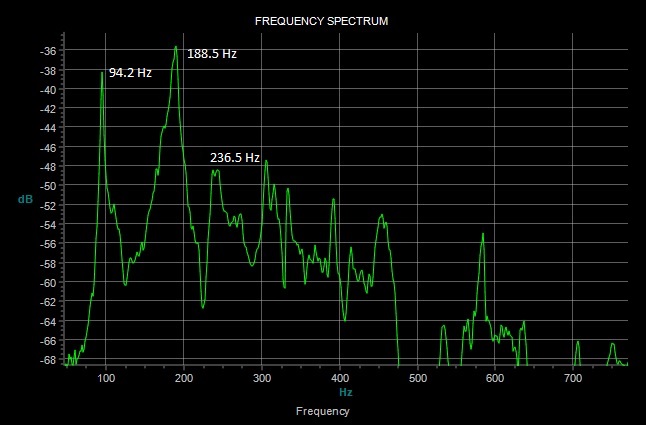
The resonance measurements came in very close to target. Top target was 190 Hz. Results: T(1,1)1 at 94.2 Hz, T(1,1)2 at 188.4 Hz, T(1,1)3 at 236.5 Hz. Nearly spot on — the top re-bracing paid off.
Compensated Nut & Saddle — Gore MethodI used the same scale length and strings as the classical example in the Gore/Gilet book, which meant I could use their pre-calculated compensation values rather than running the full spreadsheet. The nut is made using a saddle-slotting jig and a Bishop Cochran router base as a small milling machine — one turn of the fence set-screw equals 0.8mm, and readable to about one-eighth of a turn, giving approximately 0.1mm accuracy. The compensation is left slightly generous at the nut and fine-tuned once it's mounted, using a sharp chisel to nail the final positions. The saddle compensation is marked directly from the active string length measurements — measuring from the nut location on the fretboard to each string's correct intonation point.
Still to do: clean up the nut and saddle, buff out the finish, final setup in a few days, and add a side dot at the 7th fret. But it plays, it's in tune, and it sounds like what it was supposed to sound like.
Panama Rosewood / Engelmann Spruce Classical Commission
Body StyleClassical · Venetian Cutaway
TopEngelmann Spruce
Back & SidesPanama Rosewood — LMI
BracingFalcate — CF Reinforced · Gore / Gilet
Brace Height8.5mm (raised 1mm from first build)
NeckSpanish Cedar · Bolt-On / Bolt-Off
Neck AngleMahogany Wedge — 4mm to 0mm (classical negative angle)
FretboardCocobolo · 20" Radius
BridgeBrazilian Rosewood · Dual CF Fabric Layers
Nut & SaddleCompensated — Gore / Gilet Method
BindingAustralian Blackwood
Pore FillZ-Poxy (diluted seal coat on purflings first)
Finish — TopFrench Polish — Shellac
Finish — Back, Sides & NeckRoyal-Lac Shellac
Top ResonanceT(1,1)2 = 188.4 Hz (target 190 Hz)
Build PeriodMay – November 2015
CommissionDoug Rice — Classical Guitar Instructor
.jpg)
.jpg)
.jpg)
.jpg)
.jpg)
.jpg)
.jpg)
.jpg)
.jpg)
.jpg)
.jpg)
.jpg)
.jpg)
.jpg)
.jpg)
.jpg)
.jpg)
.jpg)
.jpg)
.jpg)
.jpg)
.jpg)
.jpg)
.jpg)
.jpg)
.jpg)
.jpg)
.jpg)
.jpg)
.jpg)
.jpg)
.jpg)
.jpg)
.jpg)
.jpg)
.jpg)
.jpg)
.jpg)
.jpg)
.jpg)
.jpg)
.jpg)
.jpg)
.jpg)
.jpg)
.jpg)
.jpg)
.jpg)
.jpg)
.jpg)
.jpg)
.jpg)
.jpg)
.jpg)
.jpg)
.jpg)
.jpg)
.jpg)
.jpg)
.jpg)
.jpg)
.jpg)
.jpg)
.jpg)
.jpg)
.jpg)
.jpg)
.jpg)
.jpg)
.jpg)
.jpg)
.jpg)
.jpg)
.jpg)
.jpg)
.jpg)
.jpg)
.jpg)
.jpg)
.jpg)
.jpg)
.jpg)